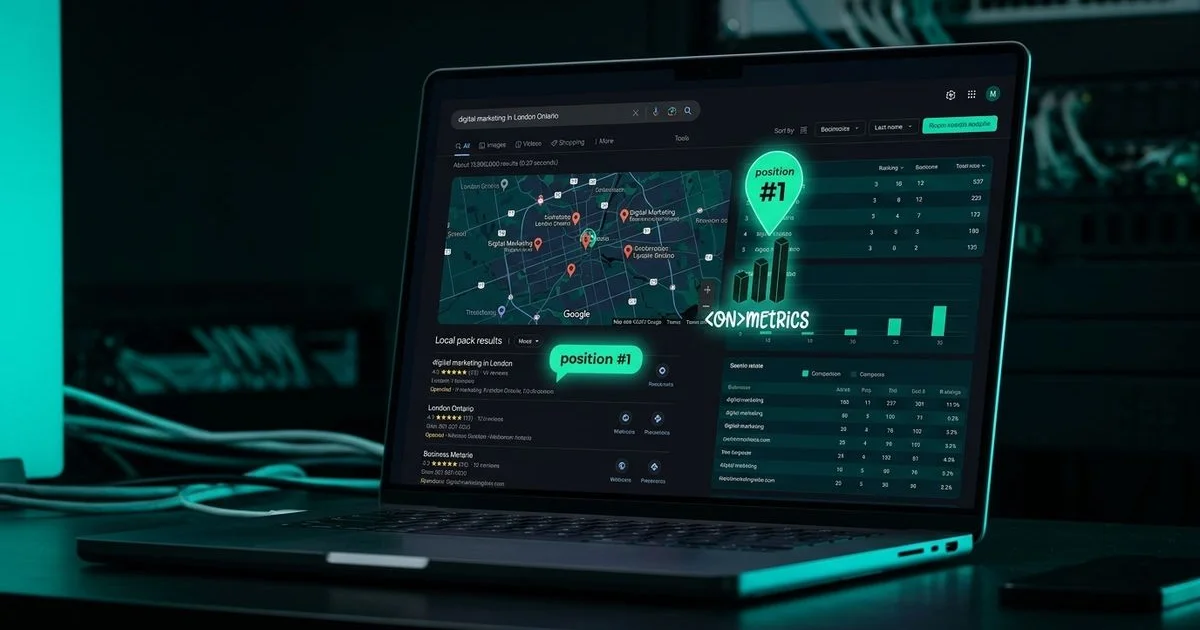
Google Business Profile local SEO works best when the profile, website, reviews, service pages, and tracking all tell the same story. The profile is not a shortcut around weak local relevance. It is one of the strongest places to make that relevance clear.
Understand the Three Local Ranking Inputs
Google says local results are mainly based on relevance, distance, and prominence.[1] Relevance is how well the profile matches the search. Distance is how far the result is from the searcher or location term. Prominence reflects how well known a business is, including web information, links, articles, reviews, and ratings.
That model is useful because it keeps local SEO honest. You can improve relevance and prominence, but you cannot make a business closer to every searcher. You also cannot pay Google for better local ranking.[1]
Complete the Profile Before Chasing Tricks
Google recommends complete and accurate business information, verification, current hours, review responses, photos and videos, and relevant details such as category and amenities.[1] Those are not glamorous tasks, but they reduce ambiguity.
A profile should match the website. If the profile categories, services, hours, phone, and landing page disagree with the site, the business becomes harder for customers and search systems to understand.
Reviews Are Trust Signals, Not Scripts
Google says reviews appear next to Business Profiles in Maps and Search and can help potential customers. It also says reviews must reflect genuine experiences and that incentives for posting, changing, or removing reviews are prohibited.[2]
The right review process is simple: ask neutrally after a real customer interaction, make the link easy to find, respond professionally, protect privacy, and value balanced feedback. Do not gate requests, pressure customers, or write suggested review language.
Support the Profile with Service Pages
The website should give the profile something useful to point at. A homepage can introduce the business, but service pages explain why a customer should choose the business for a specific need.
For ONmetrics, that means connecting the profile and service-area pages to local SEO services, relevant city pages, and guides that answer buyer questions.
Use Structured Data Carefully
Google's Local Business structured data documentation explains that markup can help Google understand local business details such as hours and other attributes.[3] Structured data is support, not a substitute. The visible page still needs clear content, accurate NAP details, and a reason to exist.
Search Essentials also warns against assuming eligibility creates guaranteed crawl, indexing, serving, or ranking.[4] That matters for GBP work because there is no single magic field that overrides poor content or weak trust.
Report on Visibility and Leads
GBP reporting should connect map actions, website visits, calls, direction requests, reviews, and lead quality where possible. A business can receive more profile views and still fail if the phone path, page, or offer is weak.
The best local SEO work builds a loop: profile improvements, site improvements, review process, tracking, and lead review. That loop is what turns map visibility into business intelligence.
Choose the Right Landing Page for the Profile
The website link on a Business Profile should support the searcher's next decision. For some businesses, that is the homepage. For others, it should be a booking page, a service page, a location page, or a page that explains a high-value offer.
The test is simple: if someone clicks from Maps, do they immediately see the service, area, proof, and next step they expected? If not, the profile may be earning attention that the website fails to convert.
Local SEO should treat that click like a handoff. The profile creates context, the landing page deepens trust, and the contact path turns interest into a measurable action.
Keep Profile Work Operational
Many GBP problems are operational, not technical. Hours change and nobody updates them. Photos get stale. Reviews go unanswered. Services are added to the business but not to the profile or site. Staff ask for reviews inconsistently, or only after someone remembers.
The fix is a recurring operating rhythm: verify core details, review categories and services, add useful photos, respond to reviews, check common questions, and compare profile actions to calls and forms.
This is not busywork when it is connected to outcomes. If profile actions rise but leads do not, the next fix might be the landing page. If reviews mention one service repeatedly, that service may deserve a better page. If direction requests rise from the wrong area, service-area language may need tightening.
Use GBP Insights as Clues, Not the Whole Story
Profile actions can show whether people are calling, visiting the site, asking for directions, or engaging with the listing. Those signals are useful, but they do not explain the whole customer journey.
Compare profile actions with website leads, call quality, service-page visits, and booked outcomes. If GBP actions rise but revenue does not, the problem may be the offer, the phone path, the landing page, or the type of searches attracting attention.
References
- [1] Google Business Profile Help, Tips to Improve Your Local Ranking. https://support.google.com/business/answer/7091
- [2] Google Business Profile Help, Tips to Get More Reviews. https://support.google.com/business/answer/3474122
- [3] Google Search Central, Local Business Structured Data. https://developers.google.com/search/docs/appearance/structured-data/local-business
- [4] Google Search Central, Search Essentials. https://developers.google.com/search/docs/essentials
Based in London, Ontario. ONmetrics provides data-driven digital marketing in London, Ontario and across Southwestern Ontario. Book a free audit →